
DIHEXA
Dihexa is a potent, orally bioavailable Angiotensin IV-derived peptide that acts as an HGF mimetic to physically rebuild brain "hardware" through rapid synaptogenesis, offering significant potential for cognitive restoration while necessitating caution due to its theoretical oncological risks.
DIHEXA OVERVIEW
Category: Nootropic Peptide, Angiotensin IV (AngIV) Analog, HGF Mimetic
How It Works: Dihexa functions by binding with high affinity to Hepatocyte Growth Factor (HGF) to activate the c-Met receptor pathway, which triggers the rapid physical formation of new functional synaptic connections between neurons.
Chemical Structure: C27 H44 N4 O5
Alternative Names: PNB-0408, N-hexanoic-Tyr-Ile-(6) aminohexanoic amide
CAS Number: 1401708-83-5
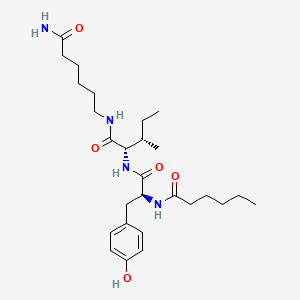
WHAT IS DIHEXA
Dihexa is a small-molecule peptide derived from Angiotensin IV. It was engineered specifically to mimic and amplify the effects of Hepatocyte Growth Factor (HGF). While most "brain boosters" focus on increasing neurotransmitters like dopamine or acetylcholine, Dihexa is a synaptogenic compound—meaning it focuses on physically rebuilding the "hardware" of the brain by creating new synaptic connections.
WHAT DOES DIHEXA DO?
The primary mechanism of Dihexa is its high-affinity binding to HGF, which subsequently activates the c-Met receptor.
-
Activates c-Met: This receptor is crucial for cell growth, survival, and differentiation across various tissue types, particularly the central nervous system.
-
Promotes Synaptogenesis: It triggers the formation of new functional synapses (connections) between neurons, facilitating improved signal transmission.
-
Potency: In laboratory assays, Dihexa was found to be roughly seven orders of magnitude ($10^7$ or 10 million times) more potent than Brain-Derived Neurotrophic Factor (BDNF), the body's natural "miracle-gro" for the brain.
BENEFITS/ CLINICAL TRIALS
Benefits:
-
Memory Restoration: Demonstrated ability to reverse cognitive impairment in animal models of Alzheimer’s.
-
Enhanced Learning: Improves the speed of acquiring new skills and information.
-
Mental Stamina: Reported increases in creative thinking and conversational fluency.
-
Neuroprotection: Shields neurons from oxidative stress and neuroinflammation.
Clinical Trial Status:
As of early 2026, Dihexa itself has primarily been validated through preclinical animal trials (rats/mice). However, a pro-drug version known as Fosgonimeton (ATH-1017) has moved into human clinical trials for Alzheimer’s and Parkinson’s disease. In animal studies, Dihexa successfully restored spatial memory to near-normal levels in models of chemical amnesia.
SIDE EFFECTS
Positive:
Improved focus, mental clarity, enhanced mood stabilization, and potential improvements in fine motor skills.
Negative (Clinical & Anecdotal):
-
Headaches: Likely due to increased metabolic demand and neurovascular shifts in the brain.
-
Irritability/Anxiety: Some users report "over-stimulation" or emotional blunting, potentially due to rapid synaptic remodeling.
-
Theoretical Risk (Oncological): Because it activates the HGF/c-Met pathway—a pathway frequently hijacked by malignant cells for migration and growth—there is a significant theoretical concern that it could accelerate the growth of existing undiagnosed tumors.
IS DIHEXA SAFE?
Dihexa is generally considered to have a high safety profile in the short-term based on animal data, but long-term human safety data is currently lacking.
Warning: It should be strictly avoided by anyone with a history of cancer or active malignancy due to its mechanism of promoting cellular growth via c-Met activation.
DOSAGE
-
Route: Dihexa is unique because it is orally bioavailable, but it is also used topically (transdermal) or via subcutaneous injection.
-
Typical Dosage: * Oral: 10mg to 20mg once daily or every other day.
-
Topical: Applied to thin-skin areas (like the inner forearm).
-
-
Half-Life: It has a remarkably long half-life; some studies suggest its effects on synapse formation can persist for days after a single dose.
Typical Subcutaneous Dosage
While there is no FDA-sanctioned human dose, common research protocols often suggest the following:
-
Standard Research Dose: 5 mg to 10 mg
-
Frequency: Once daily or every other day (EOD).
-
Cycle Duration: Usually 4 to 6 weeks, followed by a break of equal length.
-
Half-Life Factor: Estimated at 8–12 days in animal models. Because of this, some researchers prefer a less frequent dosing schedule (e.g., 10 mg twice a week) to prevent over-saturation.
-
RECONSTITUTION
Dihexa is a hydrophobic peptide and typically requires an acidic environment to fully dissolve.
Step-by-Step Reconstitution (20mg Vial)
-
The Acid Step: Add 1–3 drops of Glacial Acetic Acid (or 0.1ml of 5% Acetic Acid) directly onto the powder. Swirl gently until the powder is a clear, thick liquid.
-
The Water Step: Draw up 2 ml of Bacteriostatic (BAC) Water. Inject it into the vial very slowly, letting it run down the glass wall.
-
The Inspection: The solution should be crystal clear. If milky, add one more drop of acid.
-
Storage: Store in the refrigerator (2°C–8°C). Best used within 30 days.
Dosage Math (20mg / 2ml = 10mg/ml)
On a standard U-100 Insulin Syringe:
-
2.5 mg Dose: 25 Units
-
5.0 mg Dose: 50 Units
-
10.0 mg Dose: 100 Units (Full Syringe)
Note on the "Sting": Due to the acidity required for solubility, subcutaneous injection may cause a sharp stinging sensation for 30–60 seconds.
Step by step guidelinesWHERE TO BUY DIHEXA
Researchers should always vet their sources to ensure that a few key factors are present in their test subjects. With the rise in peptide popularity in recent years, many companies have created peptides that undergo little to no testing, quality standards, or regulations. As it is not regulated by the FDA, researchers must do their due diligence and look closely at the company's practices and standards.
When selecting a supplier for Dihexa, focus on transparency and quality assurance, not customer testimonials:
- Quality Documentation: A reputable supplier must provide:
- Certificate of Analysis (COA): This document must be recent (corresponding to the batch/lot number purchased) and demonstrate a minimum purity of >95% via High-Performance Liquid Chromatography (HPLC) testing.
- Mass Spectrometry (MS) Data: The COA must include mass spectrometry (MS) confirmation to verify the compound’s exact molecular weight, confirming its chemical identity.
- Contaminant Testing: Look for reports on heavy metals, microbial load, and solvent residues (e.g., residual trifluoroacetic acid, or TFA). The presence of these contaminants can severely compromise research and introduce unknown toxicity.
- Vendor Verification and Transparency
-
Specialization: Prioritize vendors who specialize in the manufacturing and distribution of peptides for academic and biotechnology research, rather than general supplement vendors.
-
Manufacturing Origin: Inquire about the source of the raw materials and the manufacturing protocols. Ideal suppliers adhere to strict quality control processes.
-
Handling & Storage: The supplier must provide clear documentation on the proper storage and handling procedures for the peptide to maintain its stability and integrity.
-
Conclusion on Procurement: Given the high risk of contamination, mislabeling, and legal ambiguity. The use of Dihexa outside of this defined research context poses unacceptable, unquantified risks to human health.
REFERENCES
-
Benoist CC, et al. (2014): "Dihexa, a novel synaptogenic compound, enhances cognitive function in animal models of Alzheimer's disease." Journal of Pharmacology and Experimental Therapeutics.
-
Kawas LH, et al. (2012): "Hepatocyte growth factor and the small molecule Dihexa promote synaptogenesis and improve cognitive function." Proceedings of the National Academy of Sciences (PNAS).
-
Wright JW & Harding JW (2015): "The brain angiotensin system and Alzheimer's disease: the focus on Ang IV-HGF/c-Met signaling." Journal of Alzheimer's Disease.
-
McCoy et al. (2013): "Evaluation of the blood-brain barrier permeability of Dihexa." (Preclinical pharmacokinetics study).
- PubChem CID 129010512: National Center for Biotechnology Information (2026). "PubChem Compound Summary for CID 129010512, Dihexa."
The PrepTide: Disclaimer
